


>Clean Up Space Junk or Risk Real-Life 'Gravity' Disaster <








 >Clean Up Space Junk or Risk Real-Life 'Gravity' Disaster <
Clean Up Space Junk or Risk Real-Life 'Gravity' Disaster, Lawmakers Say
 We seem to mess `up everything & don't think of the consequences of our acts.
*We sure are not taking care of Planet Earth > Makes me Sad & Mad
What do you think ? Do U Care ? (Leave it 4 someone else to clean `up)
 By By Denise Chow, Staff Writer May 10, 2014 6:54 AM

.View gallery
While the plot of the hit Hollywood film "Gravity" is fictional, the United States must bolster efforts to address the alarming amount of space junk surrounding Earth, or risk potentially catastrophic collisions in orbit, lawmakers said today (May 9). Such real-life accidents could resemble the horrifying destruction depicted in the movie, they said.
In a hearing before key members of the U.S. House of Representative's Committee on Science, Space and Technology, experts discussed the challenges of managing the growing threat of space junk. Participants included representatives from the U.S. Department of Defense, Federal Aviation Authority (FAA) and Federal Communications Commission (FCC), along with experts in space law and space situational awareness.
"Orbital debris, or space junk as it is sometimes called, is not science fiction. It is a growing problem," Rep. Eddie Bernice Johnson (D-Texas) said in her opening remarks. "Dealing with the increase in orbital debris will not be easy." [7 Wild Ways to Clean Up Space Junk]
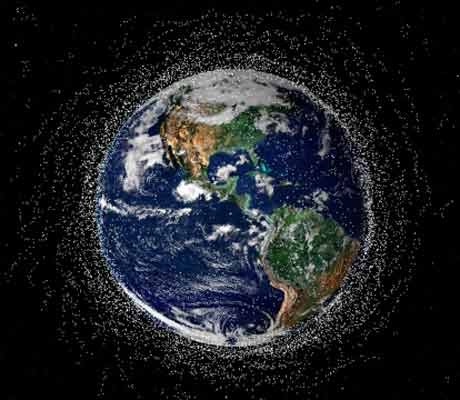
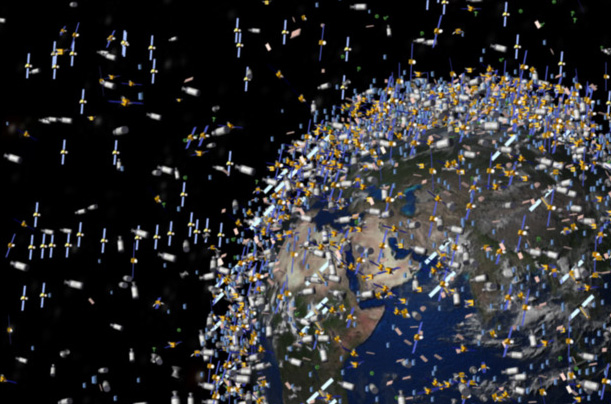
Within the Department of Defense, the Joint Functional Component Command for Space (JFCC-Space) currently tracks 23,000 objects in low-Earth orbit. NASA officials have estimated that roughly 500,000 pieces of space junk larger than a marble circle the planet, and there could be more than 100 million tiny fragments, some as small as flecks of paint, that race around Earth at blistering speeds of 17,500 mph (28,000 km/h).
George Zamka, a former NASA astronaut and the current deputy associate administrator in the Office of Commercial Space Transportation at the FAA recalled his own harrowing experiences with orbital debris during space shuttle missions.
"During my two spaceflights, we flew upside down and backwards to prevent our space shuttle windows from being hit by debris strikes," Zamka said.
View gallery

This NASA graphic depicts the amount of space junk currently orbiting Earth. The debris field is bas …
Not only have NASA space shuttles and the International Space Station had to dodge space junk over time, but two major events have added considerably to the debris problem in orbit.
In 2007, China intentionally destroyed a defunct satellite as part of an anti-satellite test that created a vast cloud of debris. The 2009 collision between two unmanned spacecraft, one a U.S. communications satellite and the other a dead Russian satellite, created even more debris.
In their testimonies, the witnesses also suggested ways that Congress might approach policies related to space traffic management.
Currently, the Department of Defense oversees surveillance of space as part of its national defense duties, yet with civil agencies, private companies and commercial space travelers all potentially sharing the space environment in the near future, it may be time to re-examine the policing of this increasingly congested orbital region, said Brian Weeden, a technical advisor with the Secure World Foundation, an organization dedicated to the peaceful and sustainable use of outer space.
"While space surveillance began as a national security function, it has evolved into more than national security," Weeden said.
View gallery

This film image released by Warner Bros. Pictures shows Sandra Bullock in a scene from "Gravity …
The FAA is the sole federal agency with the authority to grant licenses to commercial space operators. Part of this regulatory process includes working with private companies to ensure their rocket launches will not generate even more debris in orbit, Zamka said.
But, the FAA does not have the authority to regulate commercial activities in space. That job falls to the FCC for communications satellites, and to the National Oceanic and Atmospheric Administration (NOAA) for commercial Earth-watching spacecraft.
As such, determining which agency should manage space traffic will likely pose a considerable challenge, Weeden said. In his testimony, he recommended the government assign the task to an agency that already has significant expertise with mitigating space debris, or create a new federal entity to oversee space surveillance.
But to avoid any Hollywood-type disasters in space, the government must act soon, he said.
"The continued expansion in the number of space actors [and the] the type of space activities has created a complex space environment," Weeden said. "It is vitally important for the U.S. government to design an approach to stay abreast of this ongoing change."
Follow Denise Chow on Twitter @denisechow. Follow us @Spacedotcom, Facebook or Google+. Originally published on Space.com.
We seem to mess `up everything & don't think of the consequences of our acts. *We sure are not taking care of Planet Earth >
Makes me Sad & Mad What do you think ? Do U Care ? (Leave it 4 someone else to clean `up)
By By Denise Chow, Staff Writer May 10, 2014 6:54 AM .View gallery
.
.

While the plot of the hit Hollywood film "Gravity" is fictional, the United States must bolster efforts to address the alarming amount of space junk surrounding Earth, or risk potentially catastrophic collisions in orbit, lawmakers said today (May 9). Such real-life accidents could resemble the horrifying destruction depicted in the movie, they said.
In a hearing before key members of the U.S. House of Representative's Committee on Science, Space and Technology, experts discussed the challenges of managing the growing threat of space junk. Participants included representatives from the U.S. Department of Defense, Federal Aviation Authority (FAA) and Federal Communications Commission (FCC), along with experts in space law and space situational awareness.
"Orbital debris, or space junk as it is sometimes called, is not science fiction. It is a growing problem," Rep. Eddie Bernice Johnson (D-Texas) said in her opening remarks. "Dealing with the increase in orbital debris will not be easy." [7 Wild Ways to Clean Up Space Junk]
Within the Department of Defense, the Joint Functional Component Command for Space (JFCC-Space) currently tracks 23,000 objects in low-Earth orbit. NASA officials have estimated that roughly 500,000 pieces of space junk larger than a marble circle the planet, and there could be more than 100 million tiny fragments, some as small as flecks of paint, that race around Earth at blistering speeds of 17,500 mph (28,000 km/h).
George Zamka, a former NASA astronaut and the current deputy associate administrator in the Office of Commercial Space Transportation at the FAA recalled his own harrowing experiences with orbital debris during space shuttle missions.
"During my two spaceflights, we flew upside down and backwards to prevent our space shuttle windows from being hit by debris strikes," Zamka said.
View gallery
This NASA graphic depicts the amount of space junk currently orbiting Earth. The debris field is bas …
Not only have NASA space shuttles and the International Space Station had to dodge space junk over time, but two major events have added considerably to the debris problem in orbit.
In 2007, China intentionally destroyed a defunct satellite as part of an anti-satellite test that created a vast cloud of debris. The 2009 collision between two unmanned spacecraft, one a U.S. communications satellite and the other a dead Russian satellite, created even more debris.
In their testimonies, the witnesses also suggested ways that Congress might approach policies related to space traffic management.
Currently, the Department of Defense oversees surveillance of space as part of its national defense duties, yet with civil agencies, private companies and commercial space travelers all potentially sharing the space environment in the near future, it may be time to re-examine the policing of this increasingly congested orbital region, said Brian Weeden, a technical advisor with the Secure World Foundation, an organization dedicated to the peaceful and sustainable use of outer space.
"While space surveillance began as a national security function, it has evolved into more than national security," Weeden said.
View gallery
This film image released by Warner Bros. Pictures shows Sandra Bullock in a scene from "Gravity …
The FAA is the sole federal agency with the authority to grant licenses to commercial space operators. Part of this regulatory process includes working with private companies to ensure their rocket launches will not generate even more debris in orbit, Zamka said.
But, the FAA does not have the authority to regulate commercial activities in space. That job falls to the FCC for communications satellites, and to the National Oceanic and Atmospheric Administration (NOAA) for commercial Earth-watching spacecraft.
As such, determining which agency should manage space traffic will likely pose a considerable challenge, Weeden said. In his testimony, he recommended the government assign the task to an agency that already has significant expertise with mitigating space debris, or create a new federal entity to oversee space surveillance.
But to avoid any Hollywood-type disasters in space, the government must act soon, he said.
"The continued expansion in the number of space actors [and the] the type of space activities has created a complex space environment," Weeden said. "It is vitally important for the U.S. government to design an approach to stay abreast of this ongoing change."
Follow Denise Chow on Twitter @denisechow. Follow us @Spacedotcom, Facebook or Google+. Originally published on Space.com.
- Space Junk Explained: How Orbital Debris Threatens Future of Spaceflight (Infographic)
- Space Debris - How It Got There, What To Do About It? | Video
- Photos: 'Gravity' Film Showcases Smashing Action in Outer Space
- Congress: Not Taking Out 'Orbital' Trash = Economy In Jeopardy | Video
- Science
- Space & Astronomy
Last edited by BeachBumMike; May 11, 2014 at 08:45 AM.



It's your Planet `Earth > We must take care of `it ?
What `if ?
I think we need to elect people that care about people & our planet > World,
instead of electing people that are owned & dedicated to the
United States of Corporations (?)

What do you think ?
Last edited by BeachBumMike; May 11, 2014 at 08:41 AM.

 >Blast `Off<
Thank You for caring!
Going back 2 help `Space & others. It's been a `Trip 4>Sure!
p.s. Sorry the pictures are so large, but it's difficult to fit `space in the confines of a MCF Thread<

Going back 2 help `Space & others. It's been a `Trip 4>Sure!
p.s. Sorry the pictures are so large, but it's difficult to fit `space in the confines of a MCF Thread<
Last edited by BeachBumMike; May 12, 2014 at 09:27 AM.



 >Maybe> I have more present prob's 2 deal with now (?)
Thanks Mr Brent for being the 1st & maybe
 only member to post (?)
>Space is a lot 4 a person 2 absorb 4>Sure<>It's so massive & never `Ending (?)
It's sad that humans are littering planet `earth & also our `Space above....
I hope that nothing falls from Space & hurts U or someone U luv (?)
I now must `go back to my Work >`Space
Peace/Out

Last edited by BeachBumMike; May 12, 2014 at 09:24 AM.
>2 explore or not 2 explore > Your Choice<(?)

 We keep sending more stuff in2 `Space (WoW)
Hi `Brent, they are sending `up a rocket later 2day to try & find your keys (as a special birthday present 2 U) >

Delta IV Rocket Set To Launch On May 15
CAPE CANAVERAL, Florida -- The launch of a U.S. Air Force satellite aboard a United Launch Alliance (ULA) Delta IV medium configuration rocket is set for 8:08 p.m. EDT on Thursday, May 15, 2014 with an 18-minute launch window.
The Delta IV rocket will carry the GPS IIF-6 satellite into space from Space Launch Complex-37 at the Cape Canaveral Air Force Station in Florida.
As of Monday, the USAF 45th Weather Squadron forecasts that there is only a 30% percent chance overall of acceptable weather conditions at launch time. The primary weather concerns for launch are anvil clouds, cumulus clouds and lightning.
The GPS IIF-6 mission will be ULA’s fifth launch of 2014 and 82nd overall. It also will mark the 26th flight of the Delta IV launch vehicle since its inaugural flight in November 2002.
Happy B-Day `Brent

Thread
Thread Starter
Forum
Replies
Last Post