


>Put this in your Monte ?<







 >Put this in your Monte ?<
2015 Chevrolet Corvette Z06 Deep Dive: What Makes the New Supercharged LT4 V-8 Tick?
September 7, 2014 at 3:14 pm by K.C. Colwell | Photography by A.J. Mueller and the Manufacturer

When engineers at General Motors say they have created one of the lightest and most compact 650-hp engines in production, our interest is piqued and we’re paying close attention. That’s especially true when that engine, a supercharged 6.2-liter LT4 V-8, is destined for the all-new 2015 Chevrolet Corvette Z06.
Although the switch from the previous Z06′s high-revving 7.0-liter LS7 to forced induction may have upset some purists, the beating heart of Chevy’s gnarliest car is also the most powerful production engine GM has ever built. And it keeps pretty exclusive company: The list of current production engines producing 650-plus horses is a short one: the recent Hellcat Hemi V-8 from Dodge, a trio of Ferrari V-12s (found in the F12berlinetta, the FF, and the LaFerrari), the Lamborghini Aventador’s V-12, the Bugatti Veyron’s insane W-16, and the McLaren P1’s twin-turbo V-8. (The plug-in-hybrid Porsche 918 Spyder misses the cut by virtue of its V-8 producing 608 horsepower on its own.)
In addition to output, GM’s small-block needn’t worry about its size. Pushrod V-8s, such as the new LT4 andthe LT1 on which it is based, make the most of a single camshaft mounted low in the block. Dual-overhead-cam V-8s have four camshafts mounted high in the engine, making those powerplants—all else being equal—taller and wider overall, not to mention heavier. We love the sound of 32 valves banging and four cams spinning as much as anyone else, but there is an elegant simplicity to a 16-valve pushrod engine that can’t be ignored. It gets the job done.

If there’s one drawback to the design of the LT4, it’s that its single camshaft’s sole phaser can’t vary the timing of the intake and exhaust valves independent of one another. To date, the only pushrod engine with that feature is the Dodge Viper’s V-10, which has a virtual cam within a cam.
Bolting a supercharger into the vee usually adds a good bit of height, but GM worked with supercharger specialist Eaton to develop a 1.74-liter four-lobe unit—code-named R1740—that adds less than an inch to the overall height of the LT4 when compared to the blower-less LT1. The supercharger forces air past titanium intake valves and into oversquare cylinders at a maximum pressure of 9.4 psi, down from 9.7 in the C6 ZR1’s LS9. The LT4’s compression ratio is 10.0:1, which is right between that of the LT1 (11.5:1) and the LS9 (9.1:1). The camshaft profile of the LT4 also delivers greater valve lift and duration than did the LT1’s.
September 7, 2014 at 3:14 pm by K.C. Colwell | Photography by A.J. Mueller and the Manufacturer
When engineers at General Motors say they have created one of the lightest and most compact 650-hp engines in production, our interest is piqued and we’re paying close attention. That’s especially true when that engine, a supercharged 6.2-liter LT4 V-8, is destined for the all-new 2015 Chevrolet Corvette Z06.
Although the switch from the previous Z06′s high-revving 7.0-liter LS7 to forced induction may have upset some purists, the beating heart of Chevy’s gnarliest car is also the most powerful production engine GM has ever built. And it keeps pretty exclusive company: The list of current production engines producing 650-plus horses is a short one: the recent Hellcat Hemi V-8 from Dodge, a trio of Ferrari V-12s (found in the F12berlinetta, the FF, and the LaFerrari), the Lamborghini Aventador’s V-12, the Bugatti Veyron’s insane W-16, and the McLaren P1’s twin-turbo V-8. (The plug-in-hybrid Porsche 918 Spyder misses the cut by virtue of its V-8 producing 608 horsepower on its own.)
In addition to output, GM’s small-block needn’t worry about its size. Pushrod V-8s, such as the new LT4 andthe LT1 on which it is based, make the most of a single camshaft mounted low in the block. Dual-overhead-cam V-8s have four camshafts mounted high in the engine, making those powerplants—all else being equal—taller and wider overall, not to mention heavier. We love the sound of 32 valves banging and four cams spinning as much as anyone else, but there is an elegant simplicity to a 16-valve pushrod engine that can’t be ignored. It gets the job done.
If there’s one drawback to the design of the LT4, it’s that its single camshaft’s sole phaser can’t vary the timing of the intake and exhaust valves independent of one another. To date, the only pushrod engine with that feature is the Dodge Viper’s V-10, which has a virtual cam within a cam.
Bolting a supercharger into the vee usually adds a good bit of height, but GM worked with supercharger specialist Eaton to develop a 1.74-liter four-lobe unit—code-named R1740—that adds less than an inch to the overall height of the LT4 when compared to the blower-less LT1. The supercharger forces air past titanium intake valves and into oversquare cylinders at a maximum pressure of 9.4 psi, down from 9.7 in the C6 ZR1’s LS9. The LT4’s compression ratio is 10.0:1, which is right between that of the LT1 (11.5:1) and the LS9 (9.1:1). The camshaft profile of the LT4 also delivers greater valve lift and duration than did the LT1’s.
- Instrumented Test: 2015 Dodge Challenger SRT Hellcat
- First Drive: 2015 Chevrolet Corvette Stingray Eight-Speed Automatic
- Chevrolet Corvette Z06 Research: Prices, Photos, Specs, Reviews, and More
 >Love it<4>Sure<
GM 6.2 Liter Supercharged V8 Small Block LT4 Engine
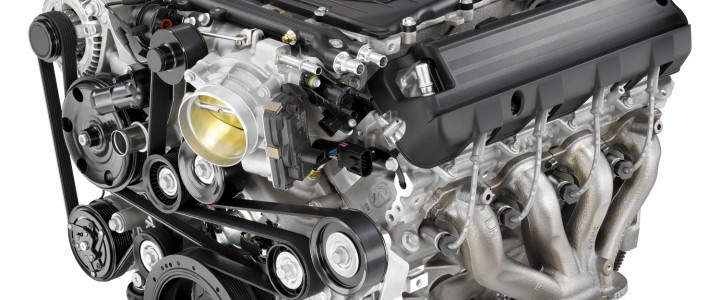
The 2015 Corvette Z06 features an all-new LT4 engine. The supercharged, 6.2L V-8 will deliver more than 625 horsepower, and 635 lb-ft of torque.
GM 6.2 Liter Supercharged V8 Small Block LT4 Engine
The LT4 is an engine produced by General Motors for use in ultra-high-performance vehicles. Part of GM’s 5th-generation Small Block engine family, the engine displaces 6.2 liters, has eight cylinders in a “V” layout, and features a purpose-built supercharger. Currently, the engine is slated to be used in the 2015 Corvette C7 Z06.
Engine highlights:
- Purpose-built supercharger: the purpose-built 1.7L Eaton supercharger allows the LT4 to be very close to the dimensions of the naturally-aspirated LT1. At 20,000 RPM, the supercharger spins faster than conventional units; that’s 5,000 RPM higher than that of the ZR1′s LS9.
- Compact dimensions: the LT4 is only one inch taller than the LT1, and is nearly identical in every other dimensional element, making it one of the most power-dense motors on the market.
- Additional features:
- Titanium intake valves
- Forged aluminum pistons
- A redline of 6,500 RPM
YOU MAY ALSO LIKE...

 Cost ? WoW > Speed Cost Big $'s
Shop for 6.2‑liter LT4 V‑8 on Google
Edelbrock 46770: Edelbrock Supercharged...
$21,635.87
Summit Racing Equipment
Chevrolet Performance 19244099: Chevrolet Pe...
$21,229.97
Summit Racing Equipment

Roush 421246 F‑150 Supercharger Kit Phase...
$6,249.99
 CJ Pony Parts
Edelbrock 46770: Edelbrock Supercharged...
$21,635.87
Summit Racing Equipment
Chevrolet Performance 19244099: Chevrolet Pe...
$21,229.97
Summit Racing Equipment
Roush 421246 F‑150 Supercharger Kit Phase...
$6,249.99






Thread
Thread Starter
Forum
Replies
Last Post
Space
Off Topic
9
Sep 7, 2009 12:57 PM
motivation2k3
Engine/Transmission/Performance Adders
4
Aug 10, 2008 11:58 AM
yfz450tricked
Engine/Transmission/Performance Adders
0
Apr 6, 2008 10:31 PM
02Carlo
Tires/Rims/Suspension
11
Mar 9, 2008 08:11 PM
